There are several bronze figures on the grounds at Blackbeard’s Castle, and guests ask about them constantly. Here is what we know.
Blackbeard himself
The largest statue — the one most people photograph — depicts Edward Teach, the pirate known as Blackbeard. He’s posed in the courtyard with the tower behind him, which is accurate to the legend if not necessarily to the history. Blackbeard operated in the Caribbean in the early 18th century and his connection to this specific tower is more story than record. But the statue looks exactly like you’d want a pirate to look, and that’s not nothing.
The composition
The statues were commissioned as part of the property’s development and are designed to give visitors a sense of the pirate history of St. Thomas. Charlotte Amalie was, in the 17th and 18th centuries, a genuinely significant pirate haven — the Danish authorities tolerated a certain amount of business that other colonial powers might have suppressed, and the harbor’s reputation attracted ships of all kinds.
The tower in context
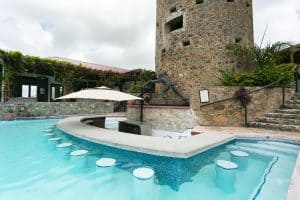
The Skytsborg tower behind the statues is the real artifact — 1679, Danish-built, one of five National Historic Landmarks in the U.S. Virgin Islands. The statues are the story layered on top of the history. Together they’re a fair representation of how St. Thomas works: the actual past, and the legend the island chose to tell about itself.
The best photo
Morning light hits the courtyard from the east, which makes the bronze figures look better than they do at noon. The tower catches the light well at any time of day. Late afternoon, when the harbor turns gold behind everything, is the best moment — but that’s true of most things at Blackbeard’s Castle.